
There is something deeply British about beer. A pint in the local pub, a pale ale from an independent brewery, a lager after work or a beer garden on a summer evening. The UK has long been celebrated for its brewing culture. So, if beer remains such a well-loved part of British life, why are breweries finding it increasingly difficult to survive? The answer is becoming hard to ignore – rising operating costs are putting growing pressure on already tight margins.
250 fewer breweries in just 3 years
According to the SIBA UK Brewery Tracker, the UK had 1,828 breweries at the beginning of 2023. By the beginning of 2026, that figure had fallen to 1,578, a net reduction of 250 breweries in three years. More concerning still, the rate of decline is accelerating. SIBA reported that 137 breweries were lost on a net basis during 2025 alone, equivalent to almost 3 breweries a week, and described the situation as a potential “survival crisis” for British beer.
Ironically, when SIBA reported that the UK had lost 100 breweries during 2024, it highlighted that this happened despite strong demand for independent beer, suggesting that the closures were being driven by pressures on breweries themselves rather than a lack of consumer interest. SIBA identified legacy Covid debt, restricted access to the pub market and tight margins as key factors contributing to the rise in closures. (SIBA, 2025). Additionally, water utility costs have increased by 57% in real terms since 2021, according to Ofwat (2025), and energy costs remain vulnerable to geopolitical events.
The pressure does not stop at the brewery door. Britain’s pubs are fighting their own battle to remain viable. In July 2025, the British Beer & Pub Association (BBPA) estimated that 378 pubs across England, Wales and Scotland would close during the year, roughly one every day. The BBPA estimated that these closures could result in more than 5,600 direct job losses and pointed to the cumulative cost and tax burden facing pubs and breweries as a major part of the problem.
It’s not one big bill – everything adds up
Running a brewery involves far more than simply making beer. There are ingredients to buy, people to employ, equipment to maintain, energy and water to consume, packaging to purchase, beer to transport and wastewater to manage. Any one of these costs may be manageable on its own. The problem is what happens when they all rise at once.
UKHospitality’s quarterly survey found that 95% of hospitality businesses had experienced increased wage costs year on year. Food costs had risen for 89% of businesses, insurance costs for 84% and energy costs for 57%. While these figures relate to the wider hospitality sector rather than breweries specifically, they illustrate the challenging environment in which pubs and brewery taprooms are trying to operate.
When operating costs rise faster than a business can increase its prices, something eventually has to give. Investment is postponed, staff hours are reduced, maintenance is delayed and expansion plans are put on hold. But there is only so far a brewery can raise the price of its beer, cut its workforce or reduce production before those decisions begin to affect the business itself. Eventually, for some breweries, continuing to trade may no longer make economic sense.
Breweries face high wastewater charges, rising energy prices, rural utility constraints and increasing pressure to reduce Scope 2 and wastewater-related emissions. For food and beverage manufacturers with average margins at a median value of 3.4% (theaccounts.co.uk, 2026), there is little room to absorb further cost increases, making efficiency essential. So, the question is not simply how breweries can sell more beer, but how they can become more efficient and reduce operating costs. One area worth looking at more closely is wastewater.
Cleaning tanks, equipment and production areas, alongside the brewing process itself, creates wastewater containing a high concentration of organic material. For breweries, managing that wastewater can become a significant operational cost, particularly where high organic loads lead to higher treatment charges. Traditionally, wastewater is viewed as something that has to be treated and removed from the site, at a significant cost. But what if it could become part of the solution instead? That is the opportunity Pipeline Organics is creating.
Turning wastewater into an operational asset
Pipeline Organics has developed 3D-printed bio-electrochemical fuel cells designed to work with high-COD (Chemical Oxygen Demand) wastewater from food and beverage production. The technology offers a different way of thinking about wastewater. Rather than treating high-strength organic wastewater purely as a cost and disposal problem, Pipeline Organics’ technology, TankArc is designed to reduce its organic load while generating direct-current electricity onsite.
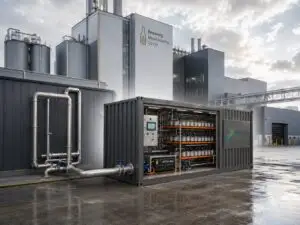
TankArc is designed to deliver approximately 85% reduction in wastewater pollutants, alongside onsite electricity generation and around 56% reduction in onsite utility costs. The actual economics depends on the characteristics and circumstances of each site. TankArc can also be applied to other high-strength wastewater streams, including cider, spirits, fruit juice, soft drinks and dairy production. Visit the website for more information.
For centuries, breweries have innovated through new styles, flavours, ingredients, packaging and ways of reaching customers. Now, they need to innovate just as decisively in their operations. Every pound spent unnecessarily on operating costs is a pound that cannot be invested in people, equipment, new products or growth. More efficient wastewater management can help breweries reduce operating costs, support margins and advance their sustainability goals. So, perhaps the future of British brewing is not simply about better beer, it is about finding smarter ways to make it.